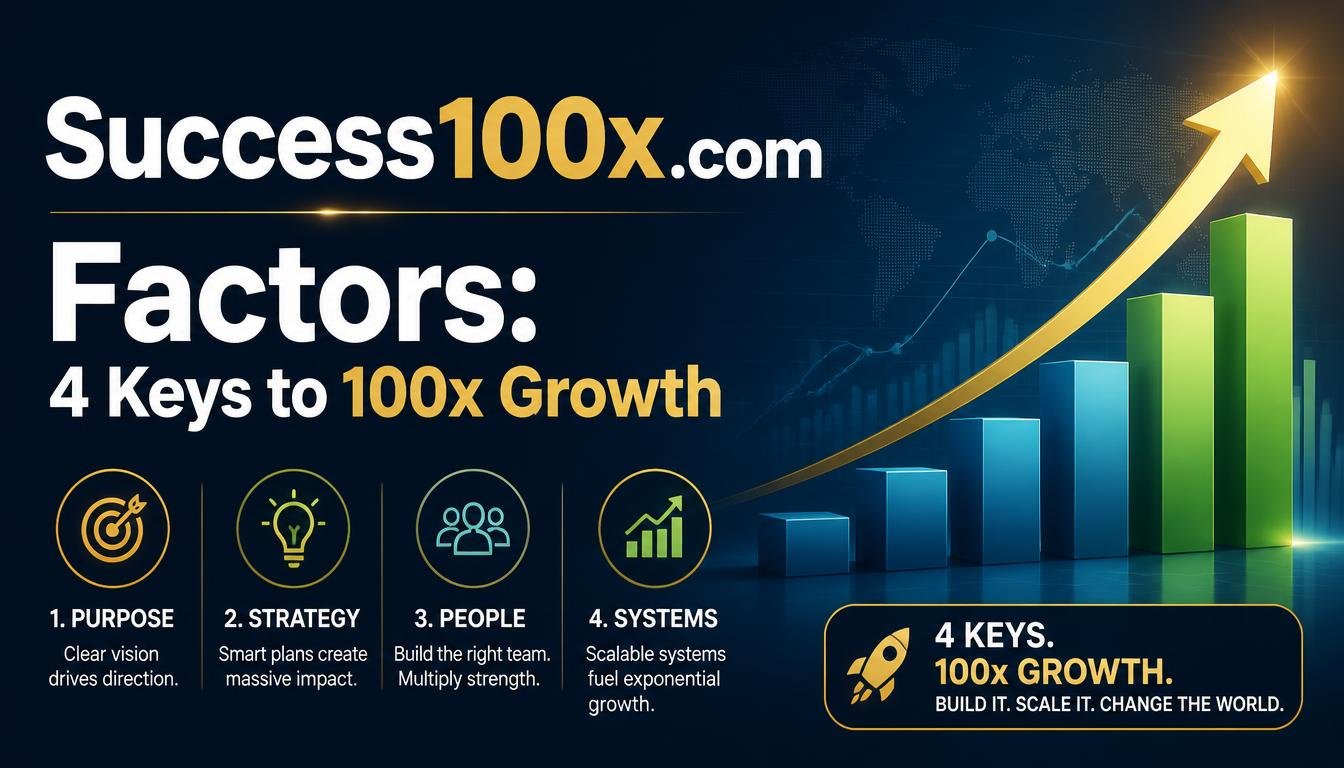
Success100x.com Factors: 4 Keys to 100x Growth
Understanding the core Success100x.com Factors: 4 Keys to 100x Growth requires looking past surface-level trends and focusing on the structural mechanics that allow companies to scale rapidly. When businesses aim for exponential expansion, they aren’t just doing more of the same; they are fundamentally altering their operational DNA. By dissecting these four pillars, leaders can identify where their current strategy may be stalling and where they can inject momentum.
This analysis provides a roadmap for those who want to move beyond incremental gains and achieve true market dominance. We will explore how these specific levers transform a standard organization into a high-performance machine capable of sustained, massive growth in competitive environments.
The First Key: Radical Operational Focus
The most common mistake growing businesses make is trying to do too many things at once. Success100x.com Factors show that the highest-growth entities prioritize a singular, razor-sharp focus on their core value proposition.
When you attempt to serve every possible market segment, you dilute your resources and confuse your messaging. Instead, successful companies isolate the one problem their product solves better than any competitor.
This focus allows a team to refine their processes until they are nearly frictionless. When your operational energy is concentrated, you can identify bottlenecks in the customer journey much faster.
Instead of managing a sprawling portfolio of mediocre services, you become the definitive authority in a specific niche. This creates a compounding effect where every dollar spent on acquisition yields a higher return because the product-market fit is so precise.
Operational focus also dictates how you handle internal communication. When everyone in the organization understands the primary objective, decision-making becomes decentralized and faster. You no longer need endless meetings to verify if a new initiative aligns with the company‘s direction.
If it doesn’t serve the core growth metric, it simply doesn’t happen. This discipline is what separates companies that plateau from those that break through to the next level.
The Second Key: Scalable Infrastructure
Growth often breaks the very systems that enabled a company to get started. Many founders find that as they move from ten employees to a hundred, their internal communication and project management tools crumble under the pressure.
Success100x.com Factors highlight that sustainable 100x growth requires building an architecture designed for volume from the very beginning. You cannot simply patch legacy systems; you must design for the scale you intend to reach.
This involves automating the repetitive, low-value tasks that consume your team’s time. If your engineers spend 30% of their week on manual deployment, you are losing massive amounts of potential output.
By investing in robust infrastructure early, you allow your people to focus on high-leverage work like product innovation and customer experience. It is a shift from working in the business to working on the business.
Scalability also refers to your ability to hire and onboard talent without losing cultural coherence. High-growth firms often document their internal processes as if they were a franchise manual.
This ensures that new hires can become productive members of the team in weeks rather than months. If your success depends on a single person’s tribal knowledge, you have a structural liability that will eventually halt your momentum.
The Third Key: Customer-Centric Feedback Loops
Growth is not a one-way street of selling; it is a cycle of listening and iterating. The most successful organizations treat their customer feedback as their primary product roadmap.
They don’t just collect data points; they build direct channels between their users and the product team. This creates a sense of trust and partnership that keeps customers loyal even when competitors offer cheaper alternatives.
You should aim for a system where customer sentiment is quantified and reviewed weekly. This doesn’t mean just looking at Net Promoter Scores, but actually analyzing the language customers use to describe their pain points.
When you speak the same language as your market, your marketing copy, sales scripts, and product features become inherently more persuasive. You stop guessing what the customer wants and start delivering it with precision.
To visualize how different strategies impact growth, we can look at the following comparison of growth-focused operational models:
Read More: FeedBuzzard Com: Complete Guide, Features & Latest Updates (2026)
| Strategy | Growth Impact | Risk Level |
|---|---|---|
| Diversification | Low/Slow | High |
| Core Optimization | High/Fast | Low |
| Aggressive Acquisition | Variable | Extreme |
| Product Iteration | Steady/High | Moderate |
The Fourth Key: High-Velocity Decision Culture
Decision-making speed is a massive competitive advantage. In a fast-moving market, a good decision made today is almost always better than a perfect decision made three months from now.
Success100x.com Factors emphasize that culture is the ultimate arbiter of how fast a company can move. If your culture requires consensus for every move, you will inevitably fall behind more agile competitors.
Leaders must foster an environment where failure is treated as a data point rather than a career-ending event. When employees are afraid to make mistakes, they hide data and slow down their output.
By framing small, controlled experiments as a necessary part of the growth process, you encourage the team to take calculated risks. This is how you discover the 1% of ideas that lead to 100x returns.
To maintain this velocity, you must empower your team to own their outcomes. If you have to sign off on every minor detail, you become the bottleneck. Instead, focus on setting clear guardrails and high-level goals.
Once those are established, give your people the autonomy to determine the best path to reach them. This builds a sense of ownership that is critical for long-term retention and morale.
Data-Driven Growth Strategies
Data is the compass that keeps a company on track during rapid expansion. Without clear metrics, you are essentially flying blind, reacting to market noise rather than actual customer behavior.
The goal is to identify the few KPIs that truly move the needle. You can learn more about how Harvard Business Review analyzes organizational effectiveness to see how these metrics correlate with long-term success.
Avoid the trap of vanity metrics like social media likes or raw website traffic. Instead, focus on cohort retention, customer acquisition cost, and lifetime value.
These figures tell you whether your growth is sustainable or if you are simply buying customers at an unsustainable price. When you understand the math behind your growth, you can reinvest your profits with confidence.
* Customer Acquisition Cost (CAC) vs. Lifetime Value (LTV) ratios.
* Churn rate reduction by onboarding optimization.
* Feature adoption rates per user segment.
* Employee engagement scores as a leading indicator of output.
* Revenue per employee to measure operational efficiency.
See More: SimplifyDiggs com Review: Content Quality, Trust & Editorial Analysis
Building a Culture of High Performance
A company is only as strong as its people. You can have the best strategy in the world, but if your culture does not support the execution of that strategy, you will fail.
High-performance cultures are characterized by transparency and a shared commitment to the mission. People need to know exactly how their daily tasks contribute to the company’s ultimate goals.
Transparency builds trust, and trust is the lubricant of a high-growth organization. When everyone understands the company’s financial position and the reasoning behind strategic pivots, they are more likely to support the changes.
This alignment reduces internal friction and allows the team to pull in the same direction. It is the intangible asset that makes the difference between a group of workers and a cohesive team.
Managing Risks During Rapid Expansion
Growth brings its own set of unique problems. As you scale, you become a larger target for competitors and regulatory scrutiny.
You also run the risk of losing the very agility that made you successful in the first place. Successful leaders anticipate these challenges by building redundancy into their systems and staying paranoid about market shifts.
Never assume that because you were successful yesterday, you will be successful tomorrow. The market is constantly evolving, and your strategy must evolve with it.
Regularly challenge your own assumptions and look for ways that your product might be disrupted. By staying ahead of the curve, you protect your gains and ensure that your growth remains on a positive trajectory.
Common Questions About Scaling
How do you know when you are ready to scale?
You are ready to scale when you have a repeatable, profitable customer acquisition model. If you are still trying to figure out if your product works, pouring money into marketing will only accelerate your losses. Ensure your unit economics are sound before you turn on the growth engine.
What is the biggest barrier to 100x growth?
The biggest barrier is almost always internal mindset. Most companies are designed for incremental growth, and they struggle to shift their processes to support exponential scale. It requires a complete rethink of how you manage time, talent, and resources.
How do you maintain culture while hiring rapidly?
Culture is not maintained through slogans or office perks; it is maintained through hiring and firing decisions. If you hire for your core values and hold people accountable to them, your culture will survive even the fastest growth phases. It is about consistency in your standards.
Can you grow too fast?
Yes, growing too fast can be just as dangerous as not growing at all. If you outpace your ability to support your customers, your reputation will suffer and you will face high churn. Ensure your infrastructure can handle the influx of new business before you push for massive volume.
How do you measure Success100x.com Factors in practice?
You measure them by looking at the velocity of your product releases, the efficiency of your customer acquisition, and the consistency of your team’s output. If these metrics are trending upwards, you are successfully applying these growth factors. If they are stagnant, you need to re-evaluate your alignment with these four keys.
Final Thoughts on Scaling Success
Achieving 100x growth is a deliberate process, not a stroke of luck. By focusing on operational precision, scalable systems, deep customer empathy, and a high-velocity decision-making culture, you position your business to capture massive market share.
The Success100x.com Factors serve as a reminder that the path to exponential expansion is paved with disciplined choices. You must be willing to let go of what worked in the past to make room for what will work in the future.
Start by identifying the one area of your business where you have the most leverage and apply these four keys immediately. Monitor your metrics, listen to your customers, and maintain the speed of your team.
The transformation from a growing company to a market leader is within reach if you stay committed to these fundamental principles. Take the next step today by auditing your current strategy against these pillars and making the necessary adjustments to accelerate your trajectory.





One Comment