5StarsStocks com Review: What Is Verifiable, What Is Not, and How to Evaluate It
When you encounter a 5StarsStocks com review, you are likely looking for clarity on whether the platform provides actionable financial intelligence or merely generic market commentary. Navigating the world of online investment resources requires a discerning eye, as many websites promise high-level insights without providing the necessary data to back them up.
This article breaks down what is genuinely verifiable about the site, how to weigh its content against your personal strategy, and the essential steps for evaluating any financial platform before you commit your time or capital. Understanding the difference between marketing hype and actual market analysis is the first step toward building a sustainable approach to the stock market.
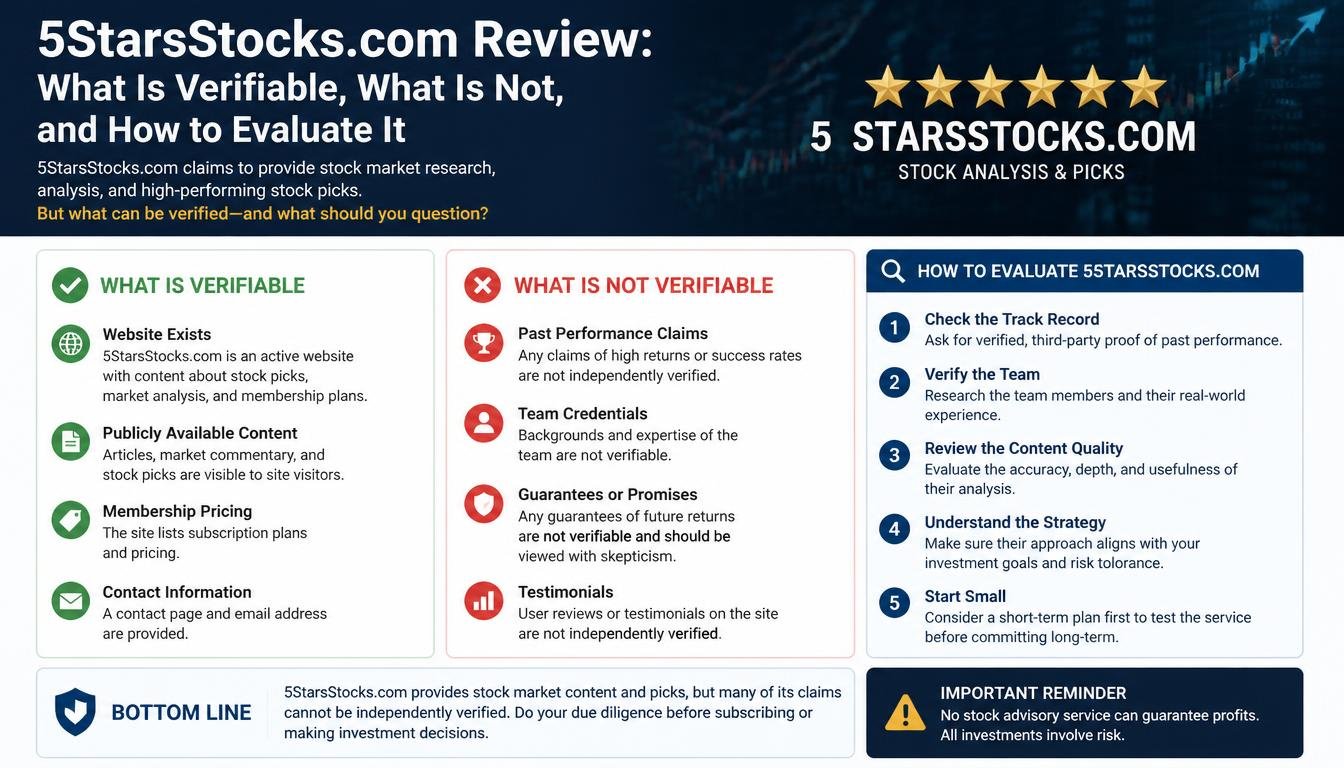
The primary reality regarding this site is that it functions largely as a content-aggregation and opinion-based platform rather than a regulated financial advisory service. When you ask what is verifiable, the answer centers on the existence of the website as a public domain and the availability of its posted articles.
You can verify that the site publishes stock-related content, but you cannot verify the success rates of its specific recommendations or the credentials of its contributors in a professional capacity. Most of the information presented relies on public market data that is widely available elsewhere, meaning the value proposition lies in the curation rather than the creation of original, proprietary financial metrics.
Distinguishing between analysis and speculation
Financial content often sits on a spectrum between hard data and speculative opinion. On platforms like this, you will frequently find articles that use historical stock performance to predict future trends. While the historical data points are verifiable, the conclusions drawn from them are inherently speculative.
A common trap for investors is treating a well-written opinion piece as a financial directive. Always check if the author provides a methodology or if they are simply highlighting a stock because of recent volatility or sector interest.
Read More: American Fashion Alaikas Com: The Complete USA Shopper’s Guide to Smarter Style
The role of transparency in financial platforms
Transparency is the hallmark of any reputable source of investment information. Legitimate financial platforms typically disclose their business model, whether they are compensated for promoting specific stocks, and who is responsible for the editorial content.
If a 5StarsStocks com review reveals a lack of clear disclosure regarding affiliate marketing or sponsored content, you should approach the site with a high degree of caution. Verifiable information is only as good as the source providing it, and a lack of transparency acts as a red flag for any serious investor.
When you evaluate the utility of a website, you should look for specific indicators of quality. Reliable platforms often link to official filings or reputable news agencies rather than relying on hearsay. You can use resources like the U.S.
Securities and Exchange Commission EDGAR database to verify the underlying financial health of any company mentioned in a report. If a site fails to provide primary source links, it is likely prioritizing engagement over accuracy.
Assessing the quality of market data
The market moves fast, and data accuracy is non-negotiable for anyone looking to buy or hold securities. Some platforms present data that is delayed or simplified to the point of being misleading for active traders.
You must determine if the charts and tables on the site are updated in real-time or if they represent a snapshot from the previous trading day. If the information is outdated, it might still have value for long-term thematic research, but it should never be the basis for a quick buy or sell decision.
Identifying the business model
Most free financial websites operate through ad revenue or lead generation. This influences the tone of the content, as platforms often favor high-volume, trending topics over less flashy, stable long-term investments.
If you notice that every article is structured to encourage a “buy” action, the site is likely optimized for affiliate clicks rather than objective financial analysis. Recognizing this pattern allows you to filter out the noise and focus on the data points that actually matter to your portfolio.
Comparing content across different platforms
It is wise to cross-reference any claim you read on a specific site with broader market news. If a particular stock is being touted as a “must-buy” on one blog but is ignored by major financial news outlets, you should investigate why that discrepancy exists.
Often, smaller sites focus on micro-cap or penny stocks that have high risk but offer little in terms of fundamental stability. Use the following table to help organize your evaluation process when you come across a new stock tip.
| Evaluation Metric | What to Look For | Red Flag |
|---|---|---|
| Source Credibility | Named analysts, cited SEC filings | Anonymous posts, no citations |
| Data Freshness | Real-time or daily closing data | Undated charts or generic stats |
| Disclosure | Clear affiliate/ad disclaimers | Hidden compensation links |
| Content Depth | Fundamental analysis/ratios | Clickbait titles, vague promises |
Building a personal verification checklist
To protect your capital, you need a systematic way to verify information before you act. Start by verifying the company’s ticker symbol through a major exchange or a trusted broker portal. Next, look for recent earnings reports and 10-K filings to see if the company’s financial story matches the narrative on the blog.
Finally, consider whether the recommendation aligns with your own risk tolerance and investment timeline. Never rely on a single source, as even the most well-meaning writers can be wrong about market direction.
Understanding the risks of retail stock content
Retail-focused content platforms often target novice investors who are looking for quick wins. This demographic is frequently served content that emphasizes “hot stocks” or “sectors to watch” without discussing the downside risks or the mathematical probability of loss.
You should be especially wary of sites that use urgent language, such as “buy now before it’s too late.” Professional financial analysis is rarely urgent; it is deliberate, methodical, and grounded in long-term performance metrics.
Common questions about financial websites
Is it safe to follow stock recommendations from blogs?
No, it is rarely safe to follow recommendations without performing your own due diligence. Blogs are often written for entertainment or lead generation, and they do not have a fiduciary duty to you as an investor.
How can I tell if a website is just trying to sell me something?
Look for excessive use of affiliate links, pop-up ads for trading courses, and high-pressure language. If the site makes money when you click a link to a brokerage, their incentive is clicks, not your financial success.
What does it mean if a stock is fundamentally strong?
A stock is considered fundamentally strong if it shows consistent revenue growth, manageable debt levels, and healthy profit margins. You can verify this by checking the company’s balance sheet and income statement on official investor relations pages.
Should I trust a site that promises high returns?
You should be extremely skeptical of any site promising guaranteed or high returns. In the stock market, high returns are almost always accompanied by high risk, and anyone promising otherwise is likely being dishonest.
How do I know if a source is reputable?
A reputable source typically provides transparent information about its authors, cites its primary data sources, and avoids sensationalized or aggressive marketing language.
Final thoughts on evaluating market content
Evaluating a site like the one discussed in this 5StarsStocks com review requires you to remain grounded in your own research. While these platforms can be useful for discovering new ideas or keeping up with broader market sentiment, they should never replace the hard work of reading financial statements and understanding the companies you invest in. By verifying the data, questioning the incentives, and diversifying your sources, you can build a more resilient investment strategy.
Take the time to build your own toolkit for analysis, and you will find that you are less dependent on the noise of the internet and more confident in your financial decisions. Always prioritize your long-term goals over short-term market trends, and remember that patience is often the most valuable asset in any portfolio.