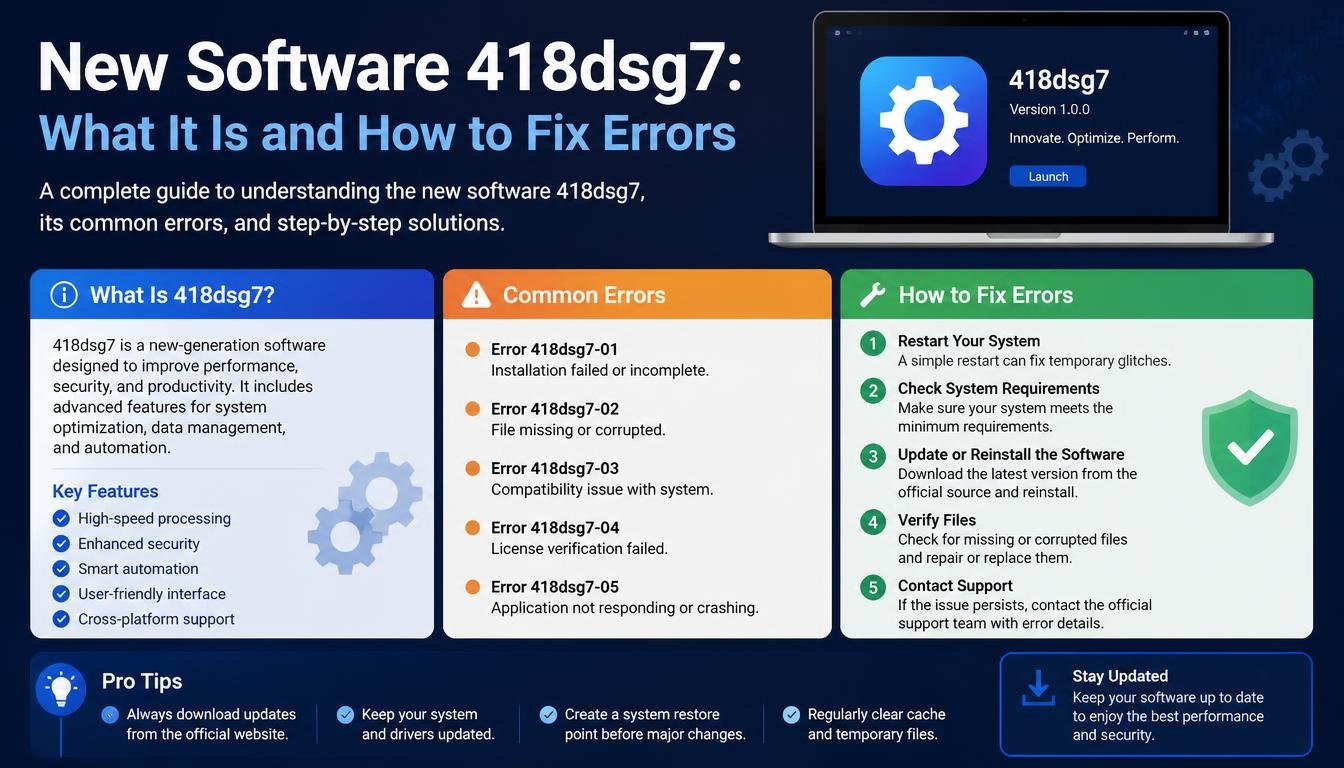
New Software 418dsg7: What It Is and How to Fix Errors
The emergence of New Software 418dsg7 has introduced a specialized tool for data management that many users are now integrating into their daily workflows. If you have recently encountered unexpected behavior while using this application, you are not alone in seeking a resolution. Understanding the core functionality of this platform is the first step toward stabilizing your digital environment.
This article provides the technical clarity needed to resolve common disruptions and keep your system running efficiently. By following these specific troubleshooting steps, you can address the root causes of performance interruptions and ensure your software remains fully operational for your professional tasks.
Understanding the Core Functions of New Software 418dsg7
At its heart, New Software 418dsg7 serves as an interface layer designed to streamline complex data retrieval tasks between local hardware and cloud-based storage. It operates by creating a virtual bridge that allows a system to access deep-directory files without manual intervention.
Developers built this tool to minimize latency during high-volume data transfers. When the architecture functions as intended, it silently manages background processes, allowing you to focus on primary applications.
The software relies on a unique algorithmic sequence to verify file integrity before execution. This verification step is what often triggers a notification if the system detects a mismatch in expected data headers.
Because it integrates so tightly with your operating system’s kernel, any minor conflict with other running processes can manifest as an error. Recognizing that the software is a facilitator, rather than a standalone database, helps in identifying why certain errors occur during peak usage.
Initial Diagnostic Steps for Common Glitches
When you encounter an error code, the most effective immediate action is to perform a clean restart of the application. This action clears the temporary cache that New Software 418dsg7 uses to store active session data.
If a simple restart does not resolve the issue, check the task manager to ensure no zombie processes are holding onto restricted file handles. Occasionally, an update failed notification might appear if the background installer was interrupted by a power fluctuation.
Always check for pending system updates before diving into deep configuration changes. Modern operating systems often require specific libraries that the software needs to execute its core commands.
You can verify the health of your installation by navigating to the application settings area and selecting the “Verify Integrity” button. This internal tool scans for missing binaries and replaces corrupted files automatically, which solves a large percentage of reported operational problems.
Resolving Persistent Error Codes
If the software continues to report a specific numerical error code, you must look at the logs to identify the culprit. Every error generated by the system is timestamped and stored in a local directory, usually located within the hidden AppData folders.
By examining these logs, you can determine if the problem is a permission-based restriction or a memory allocation failure. Most errors in the 418dsg7 series are documented by the vendor, providing a roadmap for manual intervention.
Sometimes, the issue stems from a conflict with third-party security suites that interpret the software’s background activity as a threat. You may need to add an exclusion rule for the application directory to prevent your antivirus from scanning the volatile memory segments used by the program.
This is a standard procedure for high-performance utilities. After adjusting your security settings, remember to perform a full system reboot to ensure the changes take effect across all active services.
Read More: Valan SLAP845 on Mac: Compatibility and Old Version Guide
Managing System Compatibility and Requirements
The performance of New Software 418dsg7 is heavily dependent on the underlying hardware environment. It requires a specific amount of contiguous RAM to handle the data packets it processes during heavy load times.
If your machine is running multiple resource-intensive programs simultaneously, you might trigger a memory-related crash. Users should ensure they have at least 8GB of available system memory when running this software in a production capacity.
| Configuration Metric | Recommended Value | Minimum Requirement |
|---|---|---|
| System RAM | 16GB | 8GB |
| Available Disk Space | 50GB | 20GB |
| Processor Speed | 3.2 GHz | 2.4 GHz |
| Network Latency | <20ms | <50ms |
Beyond hardware, software compatibility is equally vital for stability. Ensure that your drivers, specifically those related to graphics and chipset management, are updated to the latest stable versions.
Visit the official Windows support center for guidance on managing system-level driver updates. Keeping these components in sync prevents the software from calling upon outdated instruction sets that no longer exist in modern OS iterations.
The Role of Cache and Temporary Files
New Software 418dsg7 frequently creates temporary files to cache user preferences and recent activity logs. Over time, these files can become fragmented or corrupted, leading to strange UI behavior or sudden closes.
Clearing this cache is a safe operation that does not delete your actual data or project files. You can typically find a “Clear Cache” option directly within the main configuration panel of the application.
If the internal button fails to clear the data, you can perform a manual cleanup by navigating to the designated temp folder. Look for files with the .tmp or .cache extension associated with the software and remove them while the program is closed.
This forces the system to rebuild its temporary index upon the next launch, which often fixes lingering glitches. This proactive maintenance routine should be performed at least once a month to ensure optimal speed.
Advanced Troubleshooting via Command Line
For power users who prefer direct control, the software supports several command-line flags that can bypass problematic GUI elements. If the program crashes during startup, you can attempt to launch it using the “safe mode” flag via your terminal.
This command instructs the application to bypass non-essential plugins and visual enhancements that might be causing the instability. It is a powerful way to isolate whether a specific feature is causing the crash.
Another useful technique is using the repair flag to force a re-check of all system dependencies. By typing the appropriate command string into your command prompt, you can trigger a deep-system scan without needing to open the software interface.
This is especially helpful if the main window fails to render due to a graphics driver conflict. Always refer to the official documentation for the exact syntax, as these flags can change between different versions of the software.
Common Performance Bottlenecks
Even when the software isn’t showing an error, it may run slower than expected due to background indexing. New Software 418dsg7 periodically scans your local directories to keep its internal database current.
If you have a massive file structure, this scan can consume significant CPU cycles. You can mitigate this by limiting the “scan range” within the settings area to only the specific folders you use most often.
Network-related bottlenecks are another frequent cause of perceived instability. If the software is trying to sync with a remote server, a fluctuating internet connection can cause the interface to hang.
Try switching from a Wi-Fi connection to a wired Ethernet cable to see if the responsiveness improves. If the software stabilizes, the issue was likely packet loss rather than a software defect.
Frequently Asked Questions
Why does my software show an error code on startup?
An error code on startup usually indicates a conflict with a background process or a corrupted configuration file. Try restarting your computer and clearing the application cache to resolve the most common triggers.
Is it safe to delete the cache files for this program?
Yes, deleting the cache files is completely safe and is a recommended troubleshooting step. These files are temporary and will be automatically recreated by the software the next time it launches.
How do I know if my system meets the requirements?
You can check your system specifications by viewing your computer’s properties in the control panel. Compare these numbers against the hardware table provided in this guide to ensure your CPU and RAM are sufficient for the software’s demands.
Can I fix an update failed message without reinstalling?
You can often fix an update failure by manually downloading the latest patch from the official source. Running the installer in “Repair” mode will also attempt to fix the broken update files without requiring a full removal of the software.
Why does the software crash when I open a large file?
Large files require more contiguous memory and processing power. If the software crashes, it may be hitting a memory ceiling; try closing other open applications to free up resources before attempting to open the file again.
Maintaining Long-Term Software Health
Maintaining New Software 418dsg7 requires a balance of regular updates and periodic system hygiene. By keeping your operating system current and ensuring your hardware resources are not over-allocated, you create an environment where the software can thrive. Remember to use the built-in diagnostic tools whenever you notice a slight dip in performance, as catching these issues early prevents them from evolving into critical failures.
If you continue to experience problems after trying these steps, consider reaching out to the developer support channels with your specific error log. Providing the technical team with the exact code and a description of your system environment is the fastest way to receive a permanent patch.
By staying informed and proactive, you ensure that your digital tools remain a reliable asset in your daily work. We hope these strategies help you maintain a stable and productive experience with your chosen software.




One Comment